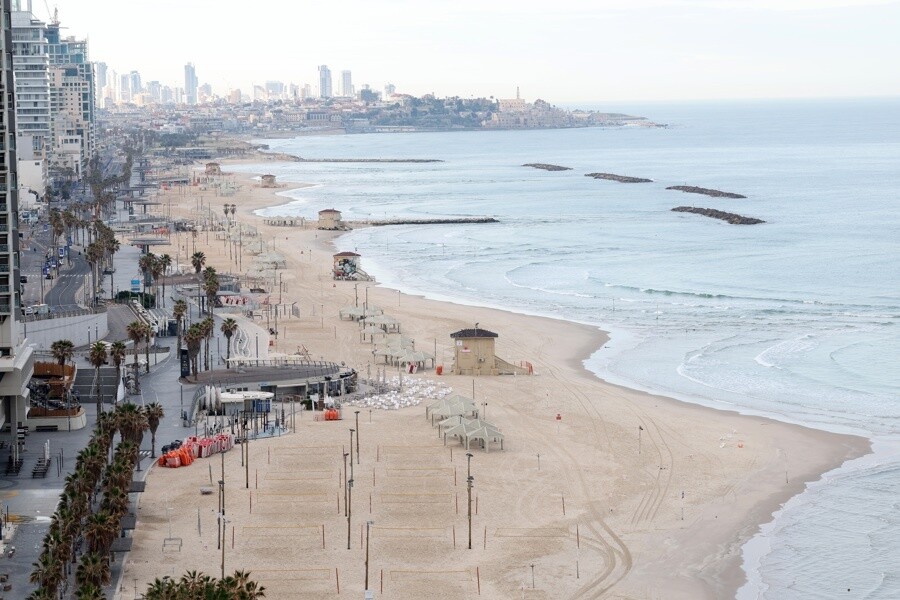
The Israeli city of Tel Aviv woke up this Sunday after an Iranian missile hit its center. The streets were semi-empty, and the night was filled with the constant sound of air raid sirens, leading some Israelis to sleep in shelters.
In Jerusalem, the sirens sounded less frequently during the first night of the war between the United States, Israel, and Iran. So far, the conflict has resulted in over 200 deaths in the Persian country and one woman killed in Israeli territory by the missile that fell in Tel Aviv.
The night in this last city was long, with sirens sounding at regular intervals, especially between six and eight in the morning, when they went off every ten minutes.
The 'Security' of the Holy City
Jerusalem is an hour's drive from Tel Aviv, where the atmosphere is more relaxed. There was only a one-hour gap without sirens being heard in the skies of Tel Aviv during the night.
Israel's Iron Dome air defense system intercepts projectiles over the city of Nablus in the West Bank, March 1, 2026.
Chain of Alerts and Alarms
Israelis receive a warning about incoming missiles about 20 minutes before they reach their territory. They do so through their mobile phones, with an alert that automatically pops up on all cell phones. Then, the apps installed on most phones go off again, at the same time as the sirens in all Israeli cities, an alert that practically coincides with the sound of missile interceptions and the possible fall of one.
So far, Israeli authorities have only reported the fall of two missiles, one in Haifa—a coastal city in the north—and the other in Tel Aviv, in the very center of the city, near important infrastructure such as the Ministry of Defense. EFE has not been able to independently verify the impact of more projectiles in Israel, where military censorship prohibits publishing the locations of impacts, especially if they are strategic.
The site of the impact in Tel Aviv, where a woman between 40 and 50 years old died, is a four-story building that was destroyed, with neighboring buildings also affected. This morning, some residents were still going to the site dressed in their pajamas to try to recover their belongings.
In the city, the atmosphere is one of tense calm, with people shopping, walking their dogs, and even exercising and fishing on the sea shore, running to shelters at the sound of the alarms.
In this city, whose eastern part and Old City are Palestinian, it did not receive any impact during the so-called twelve-day war between Israel and Iran last June. It is considered holy for the three monotheistic religions and houses the Temple Mount, a sacred place for Islam, so it is taken for granted that Iranian missiles are not aimed there.
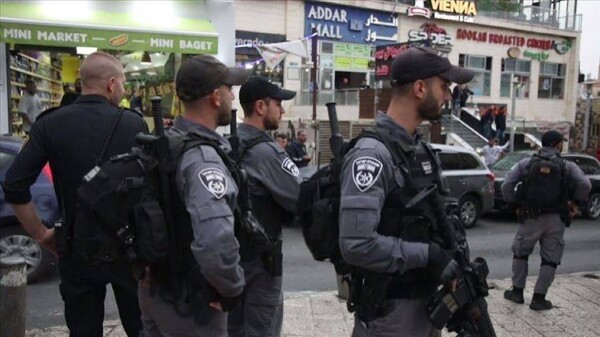
This Sunday morning, the area around the Damascus Gate leading to the Old City looked calm, with few people and Ramadan stalls closed due to the state of emergency declared nationwide. Its citizens, mostly Palestinians and ultra-Orthodox Jews in that area of the city, would look up at the sky when the sirens sounded, without going to shelters, within that feeling of security that the holy city gives.